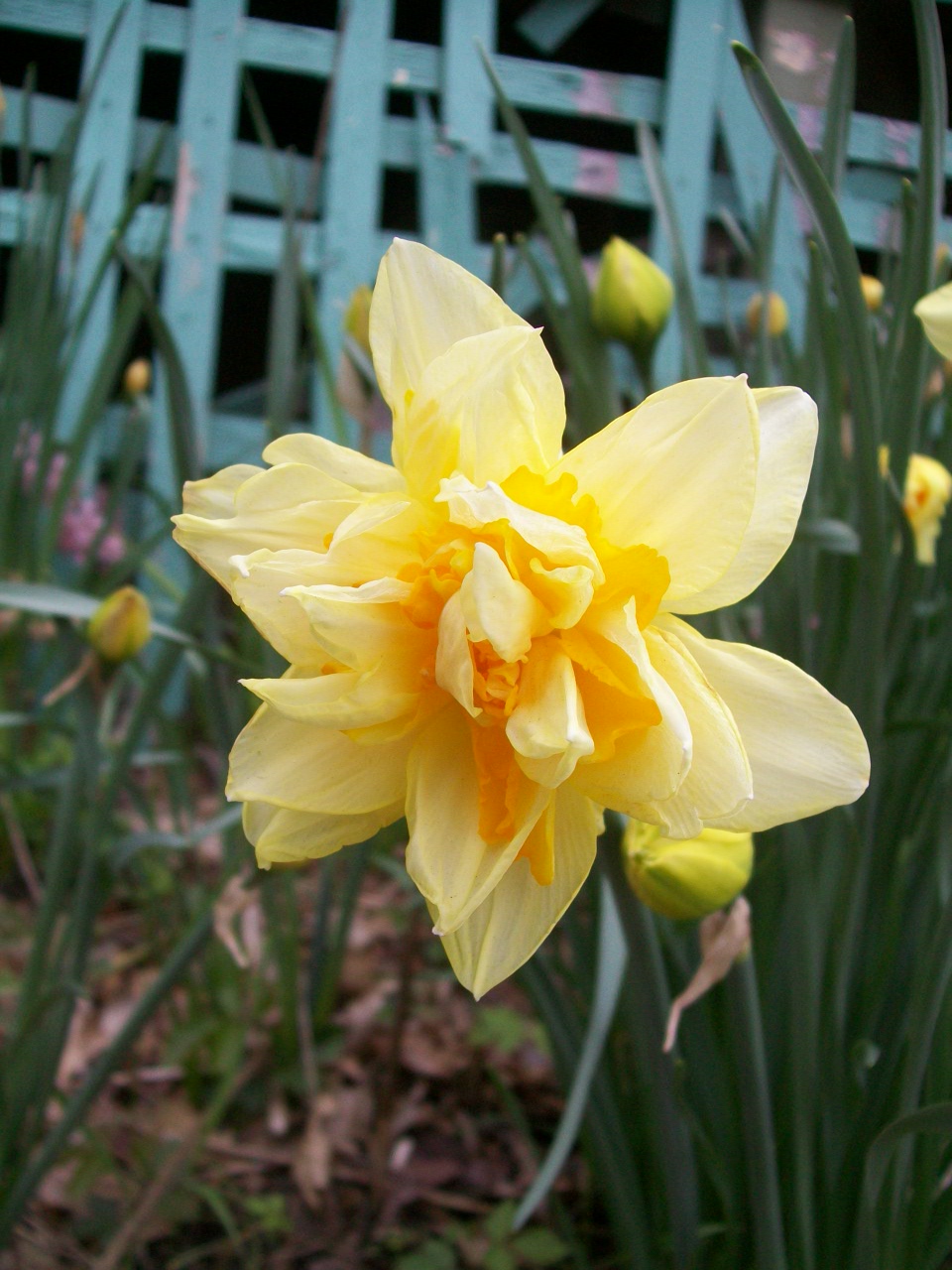
I’ve surrendered my front yard, which is about the size of a bandanna, to nature. I call it a butterfly garden, because milkweeds grow there.
There’s bulbs, too, planted by tenants from years past. Every year I get some nice daffodils and this year I got whatever that is in the picture.
These are the plants I talk to. Remember that fad in the 70’s, talking to your plants to make them grow? You don’t? Remember pet rocks? Maybe we don’t want to remember too much of this stuff.
Anyway, the daffodils near my front steps would come up in the Spring and put out promising buds– which would slowly wither and then the whole plant would keel over. I tried talking to them…
“Bloom, you suckers or I’ll tear you up by the roots!”
It was an empty threat because I was never ambitious enough to weed the garden before the whole thing became overgrown and the daffodils could hide in the tall grass.
This Spring has been unusual. Not only the deluge,but exceptionally warm weather for April. And for the first time the daffodils I was too lazy to eradicate actually flowered. They look like in the picture, double petaled, and some of them are just a disorganized mess.
Are they supposed to look like this? Is there a name for them, or are they mutants? Have I invented a new flower? Can I make money off them? If you know, please tell me.
This is a good place to mention that there’s a blog called ‘The Providential Gardener’ for good info on what’s growing in our city.
 Recurring Nightmare
“Mutation” implies that there has been an “error” or change in a gene, or its placement on a chromosome with no change in the gene but the “how” of its effect, what it does, has somehow resulted in a completely new shape, color, size, etc., of some organism. “Mutations” are probabilistic events and occur naturally every so many divisions or can be accelerated by radiation, chemicals, etc. Most “mutations” are not good, resulting in harm to the organism of varying degree, such a hemophilia in humans and some toher animals,etc. Very few have a positive or neutral impact. Because they are genetic, they can be “passed on to the next generations.” Changes can, however be the result of an injury or caused by something in the environment and not genetic at all. In thi case, the trait would not be passed on.
I suggest here are a couple of things to do before you count your money. In order to be useful, the change has to be passed on and established. You seem to have determined that the new flower is attractive and would be attractive to others so they might purchase the thing. If this is so, you will need more, lots more. I assume your plant is grown from bulbs and will generate new bulbs over the course of the season.
You need to find out if this is a unique occurence, a first, or is just a stray bulb that eneded up in the package you bought and is a known variety. The best place to check would be to look through daffodil catalogs or books to see if it is known. If you cannot find it, send the picture (and take more pictures, including the whole plant, not just the flower) to a leading nursery that specializes in daffodils. Include your history with the plant, where you purchased the bulb, the brand name, etc. If it seems new they may well be interested in the plant and request that you send it to them. At this juncture, I suggest you work out an arrangement with the nursery and generate an agreement that protects your rights as the “discoverer” of the new variety and a share in any royalties if the plant ends up being patented (I think rose varieties are patented, for example), and you may well need an attorney. I am not sure how daffodils are propagated commercially, but obviously if it is new, and has market value, there needs to be many, many of them.
Good Luck!!! At the least you have a pretty flower.
LikeLike
looking through the catalogs is a good idea, I never thought of that. thanks.
LikeLike